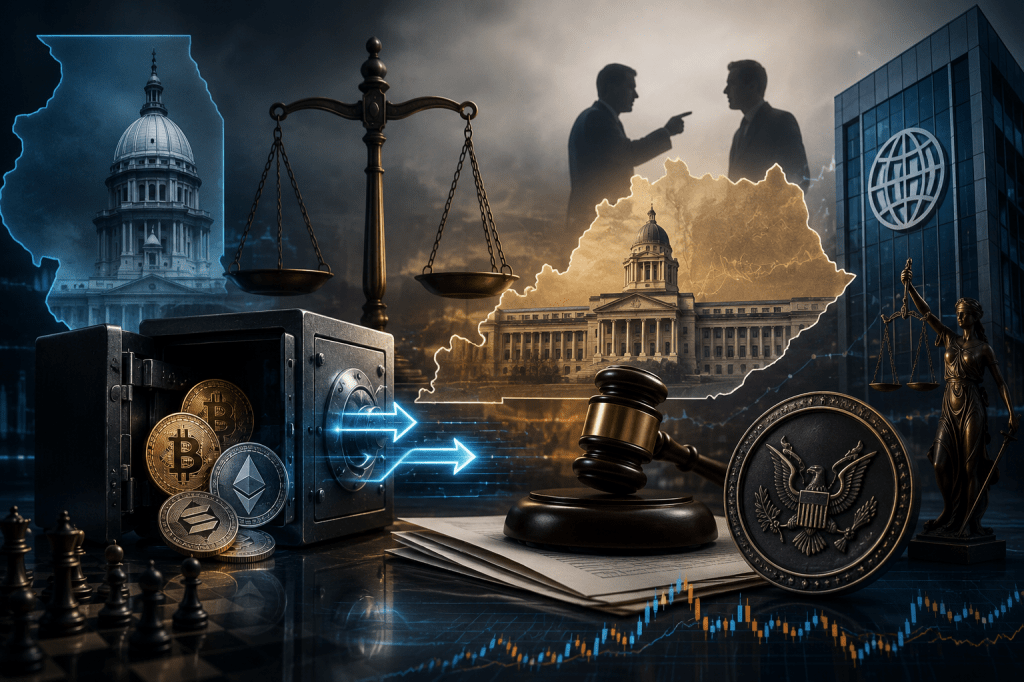
State law taxes were the story of last week with Illinois issuing a new tax for the mere storage or transfer (not just sale) of crypto which is sure to face legal challenges, and Kentucky was sued over a prediction market tax which made Kentucky turn around and sue prediction market operators. This all happened in the backdrop of the largest exchange-traded derivatives player (the Chicago Mercantile Exchange or “CME”) suing the CFTC over its perpetual futures determinations.
Here’s everything that happened last week in crypto law:
CME Sues CFTC Over Perpetual Futures Determinations
The CFTC is facing a lawsuit over the agency’s decision to allow Kalshi to offer Bitcoin perpetual contracts in the United States. CME argues that these products are legally “swaps” and therefore should be subject to a different and more restrictive regulatory regime, while the CFTC determined that they can be regulated as futures contracts and traded on a CFTC-regulated exchange. The CFTC can be expected to argue that the Commodity Exchange Act gives it the authority to apply its expertise to new financial products and that CME’s challenge is ultimately an effort to prevent new competition from entering the market. Chair Selig gave a preview of the expected arguments from the CFTC in a twitter thread.
Tl;dr– As always, the “Princess of Perps” is on top of this giving some great analysis of the CME’s suit and the Loper Bright implications for the challenge to the CFTC’s actions here. The irony of this lawsuit dropping the same week as both the SEC and CFTC issued joint Requests for Comment on the definition of “swap” should be lost on nobody. The CFTC’s strongest narrative is that this case is not about evading regulation, but about modernizing U.S. derivatives markets, applying expert agency judgment to an emerging product, and ensuring that trading activity migrates from less-regulated offshore platforms into a comprehensive federal regulatory framework. However, I am not going to lie and say that the CFTC moving quickly on this, while better for consumers, doesn’t help their case in an Administrative Procedures Act (“APA”) challenge. Something to monitor for sure.
Illinois Crypto Tax Bill
Illinois passed a law which would create a 0.2% tax on any services which store, transfer, or exchange digital assets for individuals. The Digital Chamber and Illinois Blockchain Association put out a joint statement in opposition of the 0.2% digital asset privilege tax that the Illinois legislator proposed, but it looks like those efforts were not enough to convince Governor Pritzker to veto that provision before the bill was signed into law. The tax would apply to any “broker” with more than $100,000 in receipts form Illinois customers who would need to register with the Illinois Department of Revenue to collect the tax on any qualifying “digital asset business activity” which includes any single occurrence of exchanging, transferring, or storing a digital asset as part of a business or on behalf of a customer. The law includes criminal penalties for unregistered brokers after the effective date.
Tl;dr– The entire crypto industry is understandably against this and there is a zero percent chance this goes through unchallenged in court. The fact that this was added around 2:00 AM to a 1600+ page bill with no prior warning or industry feedback makes it all the more insulting, but also makes it more easily challenged since there was seemingly zero thought or feedback on the enforceability of this type of tax. There are a ton of potentially challenges to this bill, including unequal treatment in violation of the Illinois Constitution, Commerce Clause claims under the U.S. Constitution, Due Process/vagueness challenges due to criminal implications for failure to abide by the law, and a host of other issues. Just a complete waste of time and government/private sector resources challenging taxes that will result in more legal fees being paid by both the State and private actors than this tax is ever likely to collect.
OTHER STORIES
Fearless Leader Congressional Testimony: Cody is set to testify before the Senate Banking Committee regarding how blockchain-enabled technologies create access to financial services more affordable, and then head over the House a few days later for a roundtable discussion with the Subcommittee on Military and Foreign Affairs about the ways digital assets like cryptocurrency can empower individuals living in repressive or economically unstable nations. LFG!
KPOW Index: This Political Power index from Kalshi and blog post explaining it from Paradigm are super interesting. There is obviously a lot of focus right now on sports prediction markets but we are just scratching the surface on the information that can be gleaned from people placing economic stakes out predicted outcomes.
Prediction Market Tax Dispute: The “Coalition for Prediction Markets” filed a lawsuit last week challenging an “excise tax” imposed by Kentucky on prediction market operators. Kentucky turned around and sued two members of that Coalition under state gambling law claims. Seems to be no love lost between prediction markets and the blue grass state.
Joint Banking Stablecoin Rule Proposal: A combination of all the Department of Treasury agencies released proposed rulemaking regarding the customer identification requirements for stablecoin issuers. Still need to break this down, but it seems consistent with what we submitted at The Digital Chamber to various proposals that customer identification should be limited to direct minters/redeemers and not secondary market participants.
ETH Foundation Exodus Continues: Co-Executive Director of the Ethereum Foundation, Hsiao-Wei Wang, has resigned. As an ETH bag holder and perpetual believer, my response to this news is: this is fine. Nothing to see here. It’s fine. Fine. Have I said it’s fine? Because everything is fine.
tZERO SEC Submissions: tZERO is a leader in tokenized securities and was working on it before it was hot in the streets like it is now, so when they write letters to the SEC like their recent submissions regarding the broker-dealer definition and responses to Commissioner Peirce’s RFI, they are worth reading for any securities law nerds (which, if you are reading this, there is a fairly decent chance you fall in this category). While on the topic, this cheat sheet from Galaxy Research on various tokenization models is worth having handy.
Confidential DeFi Vaults: This update hits two of my personal interests (DeFi vaults and privacy) so I had to include an update on a new product which allows users to deposit encrypted amounts of USDC without exposing their positions onchain. Super interesting.
CONCLUSION
If you have any questions or would like me to write about anything else, let me know on Twitter (X?) or Farcaster. Any typos or errors are intentional to prove I am not AI. As always, I am an attorney, I am not your attorney. For legal advice, you should always consult (and pay for) an attorney.
Outro/Disclaimer: In late 2022, while I was at Polsinelli, I started preparing weekly updates for attorneys at the firm to stay abreast of the latest Web3 legal developments. I now post the weekly updates on my personal blog every Tuesday, where I also provide links to more obscure legal developments and otherwise discuss industry trends and stories. Please note, the views and opinions I express are solely my own. They do not reflect the official stance or endorsement of the Digital Chamber or any of its members.

